
Exaptation Is Not the Goal. Value Is.
The five stages of Value Generation in Exaptation Growth Strategy (EGS), shown through how Uber turned a 10-day pilot into a $17 billion ARR business.
In 2015, Uber Eats was not generating significant orders or sales revenue and was losing money. The food selections and the number of restaurants on the platform were still limited. There was significant pressure from the board and investors to consider cutting costs and potentially shuttering the initiative. One board member asked leadership to consider ending the Eats initiative.
Ten years later, the business that board member wanted to close reported $17.2 billion in revenue and around $90 billion in gross bookings.
The exaptation itself, the moment an existing resource took on a function it was never designed for, happened when Uber’s drivers delivered a sandwich instead of carrying a passenger, took ten days in Santa Monica in the summer of 2014. The value accretion took many years. The distance between those two numbers is what this post is about.
The second half of the EGS model
In the Exaptation Growth Strategy model, the seminal interaction occurs between the exapted resource with a new or expanded function and the customer. The process of discovering exaptations is the first half of the EGS model. That novel process can feel like an abstract theory. The other half, to generate value, can be accomplished by the traditional business practices already embedded in most firms.
Across the entire EGS model, strategic value generation spans five major activities:
value discovery from exaptations,
value creation for customers,
value delivery to customers,
value capture for the firm or organization, and
sharing surplus value with the stakeholders.
For both simplicity and effectiveness, EGS places value discovery from exaptations at the beginning of the overall value generation process and growth flywheel as shown in the image below.
Side note: When I talk to professionals, they are always curious, but slightly perplexed, about Boxes 1-6 in the model. It can feel foreign with new terminology. But everything clicks when we arrive at the second half because they already know and use the concepts. For instance, Product-Market Fit in Box 7 does not require a long explanation. This is partly by design: combine abstract exaptation theory with real-world management practice!
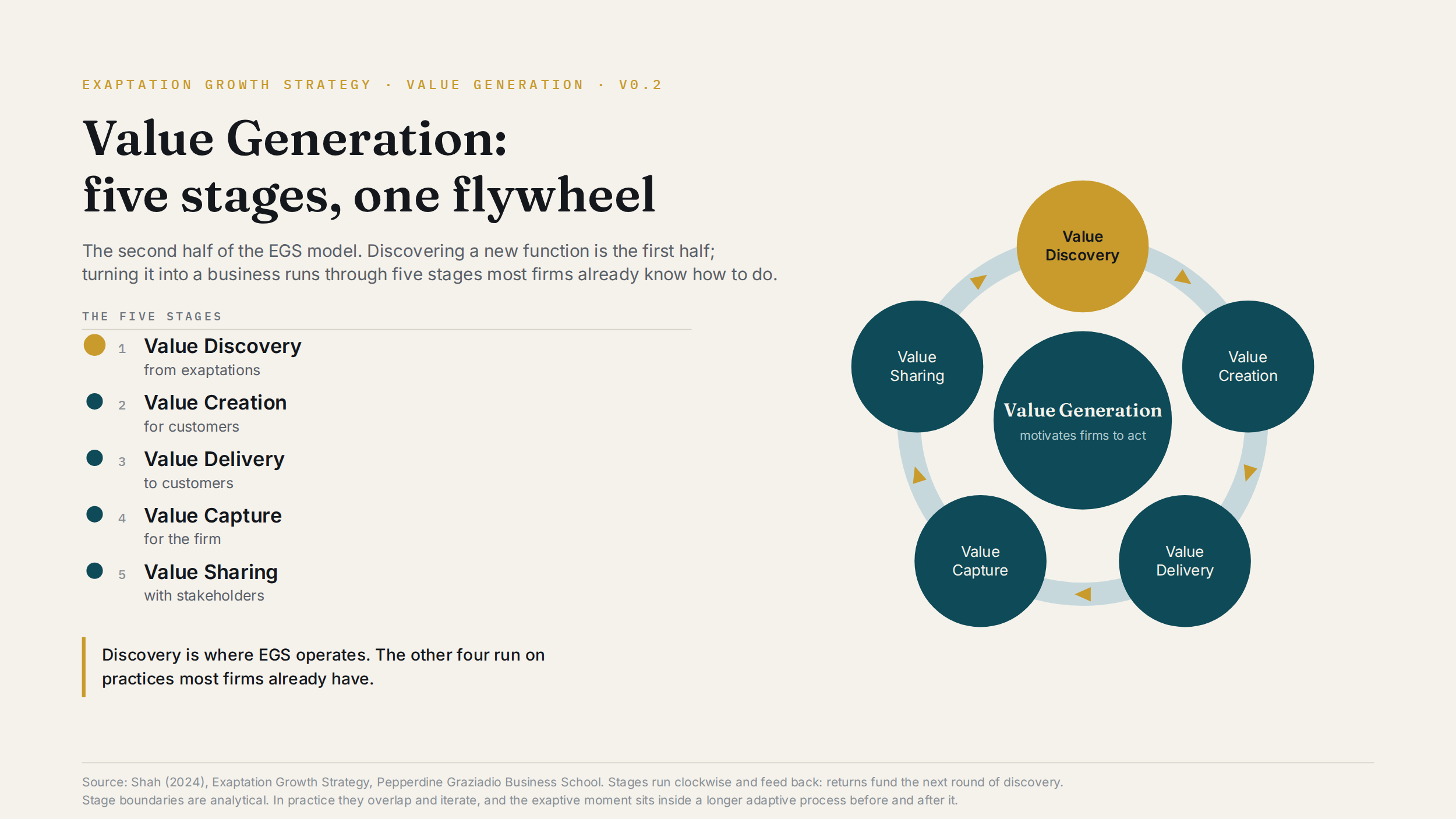
The Value Generation flywheel in EGS. Five stages, clockwise. Discovery is where EGS operates; the other four run on practices most firms already have. Source: Shah (2024), Exaptation Growth Strategy, Pepperdine Graziadio Business School.
Let’s review each with Uber Eats as the example, because every stage is visible and the numbers are public.
1. Value discovery, from exaptations
Over time, the Uber mobility app has evolved into a digital platform offering services beyond ride-hailing. But, it did not happen by accident or serendipity. In 2014, Uber created a new division called Uber Everything to house other new parts of the company that were side bets, often called a startup within a startup. Kalanick, then the CEO, hired Jason Droege to lead Uber Everything and tasked him with finding another business line for Uber. Kalanick gave Droege a specific discovery mandate: find a service that could become as big as ride-hailing.
The question the team carried is the one I now treat as the opening prompt of EGS: what else is possible with this technological architecture we have created?
Uber tried Uber Movers, to offer moving services on campus. They tried Uber RUSH, on-demand courier services by bicycle messengers, which required the company to create a whole new supply network. They tried Corner Store, same-day delivery of household items from a preselected list. Then, after months of walkabouts in urban areas, they sensed the market potential in the delivery segment. The team decided to experiment with a concept in Santa Monica. In August 2014, they ran a 10-day Uber FRESH trial with limited selections and a fixed menu during lunch hours: a sandwich, salad, soup, pasta, and drinks. Uber’s existing customers would open the app or receive a notification that alerted them to the new service. Instead of driving people around for the Rides app, the drivers picked up food from a restaurant and delivered it. The delivery service had a low flat fee of $5, was convenient, and caught on.
That is the exaptive moment: the same drivers, the same cars, the same app, doing a second job. Ten days. Everything that follows is the other four stages.
2. Value creation, for customers (think PMF)
In all six cases, the new exapted solution fulfilled existing, latent, or non-urgent needs, and in each case alternative solutions existed. By 2013, delivery services in urban areas already included startups like Grubhub, Postmates, and Instacart, and Amazon was a major competitor in most delivery-related segments. Uber was the governing entity, ensuring the three-sided Eats business model between eaters, restaurants, and drivers could work efficiently through its technology. This four-party transaction routine was incredibly complex across cultures and geographies.
During the first operating year for Uber Eats, the team learned a most valuable lesson: the Eats business was not simply Rides + Food. The transportation business was centrally reliant on speed. How can we get the service quickly to a user, and how quickly can the ride be completed so that the driver is free to take the next ride? This organizing principle of speed, which directly affected revenue, was brought to the Eats business without a second thought. The team eventually learned that speed was not the most critical factor for users when choosing food and having it delivered. Instead, it was food selection. The greater the choice of foods, cuisines, and restaurants, the higher the demand. Uber learned that simply taking an existing business approach for the first function would not generate product-market fit for the second function.
“We were totally wrong that speed was more important than selection.” — Jason Droege, Uber Everything, on Invest Like the Best (2022)
After several discussions, Droege and the team convinced Kalanick to increase the number of restaurants with their full menus on the platform that showcased food quality, allowing users to order salivating, made to order dishes. Kalanick supported the initiative by authorizing a capital investment of 300 million dollars in 2015. By 2016, Uber’s leadership and the Eats team noticed the positive sales growth, and they later realized that the Eats business could be bigger than the ride-hailing segment.
In every one of my cases the new function was followed by a period of adaptive shaping: fine-tuning, redesign, iteration toward what the market would pay for. This is that period for Uber. The exaptation gave them a promising growth bet. Value creation gave them a 2nd product line.
3. Value delivery, to customers
In each EGS case, the new agents that generated the exaptations delivered the solution to the end-customers. Uber delivered value to its stakeholders when it launched the new Eats service. Value delivery to each of the four parties was based on a delicate balance based on unit economics for each order. Within minutes, each completed order immediately delivered value to restaurants, drivers, and eaters.
Uber launched the service in Los Angeles, New York, and Toronto in 2015. Following high growth, Uber launched a standalone Uber Eats app in 2016 that was distinct from the existing mobility app. Importantly, while the consumer-facing app differed, Uber leveraged the back-end capabilities to share data across its multiple apps and generate cross-platform activity between the Rides and Eats businesses. Initially, the delivery function leveraged existing firm resources, such as the app and its users, to maximize early success.
The cases reflect that the original agents who had designed the resource, but did not discover the exaptation, were not positioned to deliver the new value to the end-users. Given their non-participation in value delivery, it becomes more challenging for them to capture the new value. Uber is the exception that shows the rule: The firm was the same so it could capture value. But the team was new, and it owned value creation and delivery from the first order.
4. Value capture, for the firm
Uber is a clear case of value capture. Through its strategic maneuverings, Uber Eats has become a very successful second business. In 2025, Uber’s Delivery segment reported $17.2 billion in revenue, about a third of the company’s total, and $3.6 billion in adjusted EBITDA. Delivery revenue grew 25% for the year; the Mobility business it came from grew 18%.
Crucially, Eats was a significant revenue driver for Uber during the Covid-19 pandemic when the Rides business suffered. It both diversified and improved the quality of revenue for the firm.
Capture is the stage a board can see. But it arrives last, and it looks very little like the growth experiment that made it possible.
5. Value sharing, with stakeholders
In our modern economy, value sharing has become an increasingly complex endeavor. Old school economics would suggest it is mere “consumer surplus.” But today, most companies have to account for platform economics, producer-surplus, and increasingly, partner-surplus.
Uber had to balance value sharing between its shareholders and stakeholders as a corporate entity in their 4-party transaction. While Uber has shared significant value with its users, restaurants, and drivers, these stakeholders often complain about whether everyone is getting their fair share of the pie. A balanced equation is a must to continue reaping the rewards from a successful exaptation of their existing asset. Including itself, a dynamic four-party value sharing model is incredibly difficult to optimize, but the rewards are spectacular.
In the long run, the question is whether positive value generation outweighs any negative outcomes, which must be determined case by case. EGS has an agnostic view: the organization decides what type of value counts.
The flywheel turns again
Throughout the journey from Rides to Eats, the base resource, consisting of Uber’s platform capabilities and its supply of drivers, has provided structural support to the expanding business lines. This initial expansion of function took several years, and the expansion continues as Uber charges ahead to freight shipping, rentals, advertising, and other industries.
The delivery function is now acquiring growth bets of its own. Grocery and retail orders were roughly 18% of Delivery bookings by the end of 2025, and advertising now rides on the same orders. In almost all exaptation cases, value sharing feeds discovery. That is why it is drawn as a wheel and not a line. Mathematically, the firm is incentivized to not capture 100% of the value and instead find the optimal balance between capture and sharing for future discovery to occur.
As new agents interact with Uber’s new business lines, additional functions of some resources may become visible over time, should the firm choose to see them.
The firm’s motive is to generate value, not to generate exaptations. Exaptations matter insofar as they produce returns beyond what the existing growth efforts already deliver.
What this means if you run a company
When searching for exaptations, value generation should be considered early in the discovery process, because the firm may need to be experienced and prepared to take advantage of new markets. Since the new market’s structure, competition, and business models are likely to differ from the existing market, the firm must carefully invest resources towards the exaptive function, especially if some market areas are considered non-core to the firm’s existing business.
The part of the Uber case most firms skip past is the good news. Four of the five stages ran on machinery Uber already had: an experimentation routine, unit economics, an app, a capital allocation decision. The only stage that needed something new was the first. The six steps, next time, are about that stage.
If this is useful to you, please subscribe to the blog or on Substack. It is free. And leave a comment on this question, because I collect these: what is one asset in your organization that is a good candidate for exaptation and value generation?